
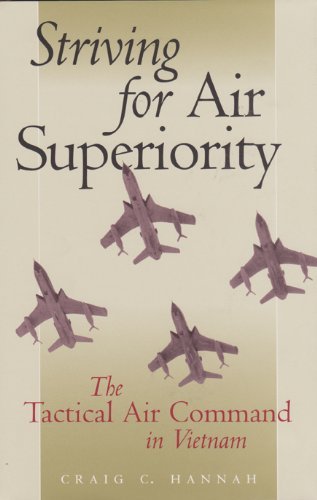
Striving for Air Superiority: The Tactical Air Command in Vietnam (Williams-Ford Texas A&M University Military History Series Book 76)
Product details
| Management number | 233370786 | Release Date | 2026/06/27 | List Price | US$10.44 | Model Number | 233370786 | ||
|---|---|---|---|---|---|---|---|---|---|
| Category | |||||||||
"Tactical bombing," Gen. Jimmy Doolittle reportedly observed, "is breaking the milk bottle. Strategic bombing is killing the cow." Most nations have historically chosen between building tactical and strategic air forces; rarely has a state given equal weight to both. The advantages of tactical air power are obvious today as small wars and petty tyrants bedevil us, but in a Cold War world split between continental superpowers, strategic bombing took precedence. According to Craig C. Hannah, the effect on America's tactical air arm was just short of calamitous.In the 1960s, the U.S. Air Force lacked both the equipment and properly trained pilots to assure air superiority because the Tactical Air Command (TAC) had become little more than a handmaiden to the Strategic Air Command (SAC). TAC focused primarily on the interdiction of enemy bombers and virtually ignored its other responsibilities, such as providing close support of ground troops with conventional weapons and the interdiction of enemy fighters over the battlefield. Its aircraft were designed to fly at supersonic speeds and shoot long-range, radar-guided missiles at large, lumbering bombers and not to engage in dog fights with highly maneuverable MiGs. Its premier fighter, the F-4 Phantom, lacked an internal cannon that was so crucial to the accomplishment of TAC's mission, and its pilot training programs were ill-suited for the air war over Southeast Asia. The arrival of surface-to-air-missiles in North Vietnam in 1965 also found the Air Force with neither the tactics nor the weapons needed to neutralize that threat.Hannah shows how a tactical air force that won a total victory in World War II deteriorated into a second-rate force flying aging aircraft during the early years of the Cold War; recovered briefly over Korea, where a combination of the F-86 Sabre and superior pilot training gave American pilots the edge in MiG Alley; then slid rapidly into obsolescence during the 1950s as defensive policy privileged the more cost-effective SAC and relegated TAC to the role of continental defense. His discussion of what makes a fighter aircraft work is superb; his explanation of why America's fighter aircraft did not work in Vietnam is instructive and unsettling.Hannah explains how TAC struggled through the war in Vietnam to emerge in the 1970s as the best-equipped and best-trained tactical air force in the world. He side-steps politics and inter-service rivalries to focus on the nuts and bolts of tactical air power. The result is a factual, informative account of how an air force loses its way and finds its mission again. Read more
Bestseller ranking
Vietnam War


Customers who viewed this product also viewed
Fire Pits


Correction of product information
If you notice any omissions or errors in the product information on this page, please use the correction request form below.
Correction Request Form